
 |
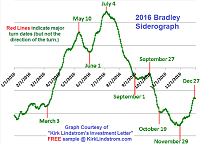
Bradley Siderograph Donald Bradley, Arch Crawford & Peter Eliades Bradley Turn Dates for 2016 |
 |
|
|
||
Historical
CD
Rates |
List of Bradley Turn
Dates for: 2007,
2008,
2009,
2010,
2011,
2012, 2013, 2014, 2015
& 2016 .... check back for 2017 Best Savings Account Rates |
iBonds |
|
The Bradley siderograph was
developed in the 1940's by Donald Bradley to
forecast the stock markets. Bradley assigned
numerical values to certain planetary
constellations for every day, and the sum is the
siderograph. It was originally intended to
predict the stock markets. William Eng, a noted
technical analyst, singled out the Bradley as
the only 'excellent' Timing Indicator in his
book, "Technical
Analysis
of Stocks, Options, and Futures" (source:
Astrikos).
Kirk
Lindstrom's
Investment Letter: Send for a FREE SAMPLE ISSUE
today!
Many traders and financial astrologers
misunderstand the Bradley siderograph. The
Bradley siderograph does not reliably predict
the direction but only turning points in the
financial markets (stocks, bonds, bonds,
commodities) within a time window of +/- 4
calendar days. Some incorrectly report "Bradley
inversions" which cannot occur because the
Bradley Siderograph does not reliably indicate
trend directions. In addition, it is not a
timing tool for short-term trends but rather for
intermediate-term to longer-term trends because
the turning window is +/- four calendar days.
|
|
| Peter
Eliades
of "Stock Market Cycles" wrote, "The indicator was
devised in the 1940s by Donald Bradley. He assigned
numerical values to the position of planetary
constellations for each day and used the sum of
those calculations to draw a siderograph, the prefix
"sidero-" in this case standing for stars or
constellations." Eliades also wrote "Theoretically,
the dates of the turns in the Bradley are more
important than the actual magnitude of the moves,
but the recent indications of turns have been eerily
accurate." |
